She Cut the Seamstress’s Measuring Tape in Half and Tossed Money on the Table—Then Her Fiancé Knelt Down and Called the Woman “Mom”.

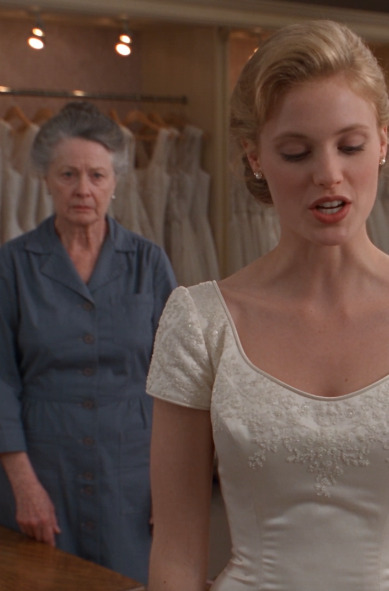
The bridal boutique smelled of lavender and old wood. The mirrors along the walls caught fragments of the afternoon light and threw them back in soft, broken pieces. Ivory gowns hung like ghosts on their racks, their beads and lace catching the glow of the lamps. A wooden sewing table sat near the window, covered in pins and thread and the quiet clutter of a woman who had spent her life making other women beautiful.
Helen was on her knees before anyone arrived. She had been on her knees for most of the morning, adjusting hems and pinning lace and doing the invisible work that no one ever noticed until something went wrong. She was sixty-three years old, and she had been a seamstress for forty of those years. She had dressed brides who cried, brides who laughed, brides who thanked her, brides who forgot her name the moment the photographs were taken. She had learned to be invisible. She had learned to be patient. She had learned to keep her hands steady even when her heart was not.
Vanessa stood above her in an ivory wedding gown, the fabric pooling around her feet like a frozen wave. She was young, and she was beautiful, and she knew both of those things with the certainty of someone who had never been told otherwise. She had been standing in front of the mirror for nearly an hour, turning this way and that, watching the way the light caught the beads on the bodice. She had not looked at Helen once.
Andrew was not there yet.
Helen reached up to adjust the bodice. Her fingers were careful, practiced. She had made hundreds of wedding dresses. She had sewn thousands of seams. She had fixed zippers and replaced buttons and rescued gowns that other seamstresses had ruined. She knew exactly how much pressure to apply, exactly where to pin, exactly how to make a dress fit like it had been made for the woman wearing it.
Vanessa looked down at her. She did not smile.
“You won’t touch my dress again.”
Helen’s hands stopped. She did not pull them away. She did not argue. She simply waited, her fingers still resting on the fabric, as if she were hoping that the words had been a mistake.
They had not been a mistake.
Vanessa reached for the measuring tape that hung around Helen’s neck. She lifted it, studied it, and then picked up the dressmaking scissors from the sewing table. The blades caught the light. The snip was quick, decisive, final. Two pieces of yellow fabric fell at Helen’s feet.
The sound of the scissors was sharp and clean. It cut through the quiet of the boutique like a small, cruel bell.
Vanessa tossed a folded stack of cash onto the sewing table. It landed with a soft thud, next to a spool of white thread. The bills were crisp and new. They did not belong in a place like this, where money was never discussed, where everything was handled through accounts and invoices and quiet arrangements between families who understood how the world worked.
Helen said nothing. She bent down and began to gather the damaged tape. Her knees cracked. Her back ached. She did not look up. She did not want Vanessa to see her face. She did not want to give her that satisfaction.
A small silver thimble rolled off the edge of the table and disappeared beneath a nearby chair.
The boutique door opened. A bell above it chimed once.
Andrew entered holding a bouquet of pale roses. He was wearing a charcoal suit, and his face was open and kind in a way that made him look younger than he was. He had dark hair that fell across his forehead, and he smiled when he saw Vanessa, and the smile was genuine. He had not seen her in three days. He had missed her.
Vanessa’s expression changed instantly. The coldness vanished. She smiled, and the smile was real, or real enough. She crossed the room and kissed him on the cheek.
“You’re early,” she said.
“I wanted to surprise you.”
She took the bouquet and held it against her chest. The pale roses looked almost white against the ivory of her gown. She looked, for a moment, like a painting of a bride—perfect, untouchable, serene.
Then she gestured toward Helen, who was still kneeling on the floor, still gathering the pieces of her tape.
“Tell them to send someone better.”
Andrew did not answer right away. He looked past Vanessa, past the mirrors, past the racks of ivory gowns. He looked at the woman on the floor.
He noticed the torn measuring tape in her hand. He noticed the way she was kneeling, the way her shoulders were curved inward, the way she was trying to make herself small.
He set the bouquet down on the sewing table.
He walked toward Helen.
He knelt beside the chair and reached underneath it. His fingers found the small silver thimble. He picked it up and held it in his palm.
Then he looked at Helen.
“Mom?”
Helen raised her eyes. They were wet, but she was not crying. She had learned long ago not to cry in front of brides. She had learned long ago to keep her face still, to keep her hands steady, to keep her heart in a place where no one could reach it.
But she could not keep her eyes from meeting her son’s.
Vanessa’s smile disappeared.
The silence in the boutique was absolute. The mirrors held their breath. The ivory gowns stood still on their racks. The clock on the wall ticked once, twice, three times.
Andrew stood. He stood beside his mother and turned toward Vanessa. His voice was quiet, but it carried through the room like a stone dropped into still water.
“What did you do?”
Vanessa opened her mouth. No words came out. She looked at the torn tape on the floor. She looked at the cash on the sewing table. She looked at Andrew’s face, which was no longer kind, no longer open, no longer the face of a man who had missed her.
The thimble glinted in Andrew’s hand.
Helen remained on the floor, the torn tape still clutched in her fingers, watching her son.
She had not told him where she worked. She had not told him that she was the one who had been assigned to his fiancée’s dress. She had not told him because she had wanted to see him. She had wanted to be near him, even if he did not know she was there. Even if she had to kneel on the floor and pin hems and gather torn tape while the woman he loved looked through her like she was furniture.
She had wanted to see the life he was building.
She had not expected it to end like this.
Vanessa took a step back. The bouquet slipped from her arms and fell to the floor. The roses scattered across the carpet, pale and soft and suddenly out of place.
“I didn’t know,” she said. “I didn’t know she was your mother.”
Andrew looked at her. “That’s not what I asked.”
Helen rose slowly to her feet. Her knees ached. Her back ached. She held the two pieces of the measuring tape in her hands, and she looked at her son, and she looked at the woman who would have been her daughter-in-law.
“I should go,” she said.
“No,” Andrew said. “You should stay.”
He turned to Vanessa.
“I asked you a question.”
Vanessa’s face was pale. Her hands were trembling. She looked at the cash on the table, at the torn tape on the floor, at the thimble in Andrew’s hand.
“I told her not to touch my dress,” she said. “She was just a seamstress. I didn’t know.”
“You cut her measuring tape in half,” Andrew said. “You threw money at her like she was a servant. And you told me to ask them to send someone better.”
Vanessa said nothing.
Andrew looked at his mother. Then he looked at Vanessa.
“I think we need to talk,” he said.
He did not raise his voice. He did not shout. He simply stood there, beside his mother, holding the small silver thimble that had rolled beneath a chair.
The boutique was silent.
The clock ticked.
And somewhere in the back of the store, a door opened and closed, and the bell above it chimed once more, as if it were marking the end of something.