The Lawyer Said a 16-Year-Old Cannot Be a Guardian—Then a 6-Year-Old Boy Raised a Photograph and Changed Everything.101

The courtroom was cold. Not temperature-cold, but cold in the way that places of judgment always are—sterile, impersonal, filled with the quiet weight of decisions that change lives. Luke sat in the front row, his hands clasped tightly in his lap, his knuckles white. He was sixteen years old. He was old enough to drive. Old enough to work. Old enough to remember everything.
But not old enough to be a guardian.
Not old enough to keep his brother.
Milo sat beside him, his small hand wrapped around Luke’s arm. He was six years old. He did not understand everything that was happening—the lawyers, the judge, the papers, the whispered arguments. But he understood enough. He understood that they were trying to take him away. He understood that Luke was fighting to keep him.
“Please,” Luke said, his voice cracking. “Please. He’s all I have left.”
The judge, an older woman with grey hair and kind eyes, looked at him with something that might have been sympathy. But sympathy was not the law. Sympathy was not enough.
“I understand your situation, Mr. Vance,” she said. “But the law is clear. A minor cannot be appointed as a legal guardian. Your brother will need to be placed with a responsible adult.”
Luke’s heart sank. He had known this was coming. He had known from the moment the social worker had knocked on their door three months ago, after the fire, after everything. But knowing did not make it easier. Knowing did not make it fair.
“I’m his brother,” Luke said. “I’m his family.”
“Family is not the only consideration.”
“He needs me.”
“He needs stability. He needs a home.”
“I can give him that.”
The judge did not answer. She simply looked at the papers in front of her—the papers that would decide Milo’s future.
And then Derek stood up.
He was sitting in the back of the courtroom, dressed in a suit that probably cost more than Luke’s entire wardrobe. He smiled—a practiced smile, a polished smile, the kind of smile that was meant to reassure. But Luke saw something else in his eyes. Something cold. Something calculating.
“I’ll take them both,” Derek said. “I’ll give them everything they need. A home. An education. A future.”
The judge looked at him. “You’re their uncle?”
“Their father’s brother. Yes.”
“And you’re willing to take legal custody of both children?”
“Absolutely. Family should stay together.”
Luke felt his stomach turn. Derek had not come to the funeral. Derek had not called. Derek had not done anything for them in the three months since their parents had died. And now, here he was—smiling, confident, ready to play the hero.
The judge nodded. She picked up her pen.
And then Milo moved.
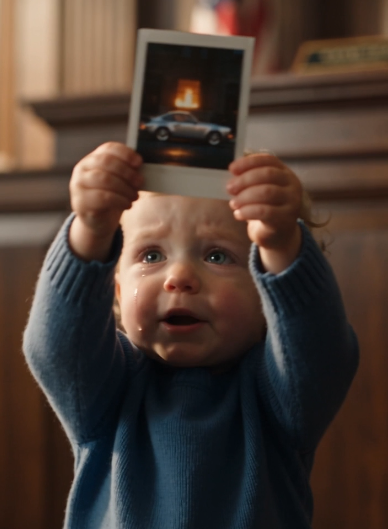
He jumped off the bench and ran to the front of the courtroom. Before anyone could stop him, he was standing in front of the judge’s bench, holding up a photograph.
“Mr. Judge!” he said, his voice high and clear. “I took this picture the night of the fire!”
Derek’s face went pale.
The judge took the photograph. She looked at it for a long moment. Then she looked at Derek.
“This is your car, Mr. Vance.”
“I was in Chicago that night!”
Milo pointed at him. “You hugged Daddy at the door! Then you drove away!”
Luke stood up. His heart was pounding. His hands were shaking.
“You told us you didn’t see them that week,” he said. “You told us you were in Chicago.”
Derek’s smile had disappeared. His face was white. His hands were clenched.
The judge looked at the photograph again. Then she called for the bailiff.
—
**The Photograph**
The photograph had been taken by a child. It was slightly blurry. It was poorly framed. But it was unmistakably clear.
It showed a car—a black sedan—parked in front of the Vance family home. It showed a man—Derek Vance—standing on the porch, embracing another man—Luke and Milo’s father. It showed the timestamp in the corner: 11:02 PM. Just minutes before the fire had started.
Luke remembered that night. He remembered waking up to the smell of smoke. He remembered grabbing Milo and running out of the house. He remembered watching the flames consume everything they had ever known.
But he had not remembered the car. He had not remembered Derek.
Milo had.
Milo had been awake. He had been looking out the window. He had seen Derek. He had seen the hug. He had seen the car. And he had taken a picture with the camera his father had given him for his birthday.
“What is this?” the judge asked.
Derek was sweating. “It’s nothing. I was there earlier. I left before the fire.”
“But you told the court you were in Chicago.”
“I was confused. It was a stressful time.”
“You were not confused, Mr. Vance. You lied.”
—
**The Truth**
The investigation moved quickly after that. Phone records placed Derek in the area at the time of the fire—not in Chicago. Security footage from a neighbor’s house showed his car driving away from the scene. And a re-examination of the fire site revealed traces of accelerant.
It was not an accident. It was arson.
Derek had been in debt—over five million dollars from bad investments. He had asked his brother for help. His brother had refused. The family business was failing, but Luke and Milo’s father had refused to sell his shares. He had said he would rather lose everything than give his brother a single cent.
That night, Derek had gone to the house. He had argued with his brother. He had threatened him. And then he had set the fire.
He had believed that if his brother was gone, the shares would go to him. And if he had custody of the children, he would control everything—the house, the money, the future.
But he had not counted on Milo. He had not counted on a six-year-old boy with a camera and a sharp memory.
—
**The Verdict**
Derek was arrested outside the courthouse. He did not go quietly. He shouted. He struggled. He screamed at Luke.
“You think you’ve won? You think you’re safe? You don’t know anything!”
Luke stood in the doorway, holding Milo’s hand. He did not answer.
“You’ll find out! You’ll find out what your grandmother did! Ask her! Ask her who called me that night!”
The police officers dragged Derek away. The shouting faded. The courthouse grew quiet.
Luke looked at Milo. Milo looked at Luke.
“What did he mean?” Milo asked.
“I don’t know,” Luke said. “But we’re going to find out.”
—
**The Grandmother**
The judge granted temporary custody to their grandmother—their mother’s mother, a woman who had been living in a small apartment across town. She had been at the hospital when the children were born. She had been at the birthdays and the holidays and the school plays. She had been there.
But she had not been at the courthouse. She had not come to the hearing. She had said she was too sick, too tired, too old.
Luke had not thought much about it. He had been too focused on keeping Milo. He had been too focused on fighting Derek.
But now, as he drove to her apartment, Derek’s words echoed in his mind.
*Ask her who called me that night.*
He knocked on the door. It opened.
His grandmother stood in the doorway. She was old—in her eighties, bent and grey, her hands trembling as she held onto the frame. But her eyes were sharp.
“You found out,” she said.
“Found out what?”
“That I called Derek.”
Luke felt the floor drop beneath him. “You called him?”
“I didn’t know what he was going to do. I swear to you, Luke. I didn’t know.”
“Why did you call him?”
“Your father—he was in trouble. The business was failing. He owed money to dangerous people. He wouldn’t listen to me. He wouldn’t sell the shares. I thought Derek could talk some sense into him. I thought—I thought he could help.”
“So you called him.”
“I called him. I told him to come. I told him to talk to your father. I didn’t know—I didn’t know he would—”
She started to cry. Luke stood frozen, unable to move.
Milo tugged at his sleeve. “Luke? Is Grandma okay?”
Luke looked at his brother. He looked at his grandmother. He looked at the photograph in his pocket—the one Milo had taken, the one that had changed everything.
“I don’t know,” he said. “But we’re going to be okay. We’re going to figure this out.”
He took Milo’s hand.
“We always do.”
—
**The Aftermath**
Derek was sentenced to life in prison. The evidence was overwhelming. The phone records, the surveillance footage, the accelerant, the photograph—all of it pointed to him.
Luke was granted a special dispensation to remain Milo’s guardian after he turned eighteen. The judge, moved by his dedication and his love for his brother, made an exception.
Their grandmother was not charged. She had not known what Derek would do. But she had known something was wrong. She had known she was making a mistake. She had just been too afraid to admit it.
She apologized. Luke forgave her. Milo hugged her.
And the three of them—Luke, Milo, and their grandmother—started to rebuild.
—
**The Lesson**
Never underestimate a child. Never assume they do not see. Never assume they do not remember.
Milo was six years old. He was small. He was quiet. He was grieving. But he had a camera. He had a memory. He had a photograph.
And that photograph saved him. It saved Luke. It brought a criminal to justice. It changed everything.
Because sometimes the truth is hidden in the most unlikely places—in the hands of a child who was paying attention when no one else was.