Two People in Their Eighties Counted Out Pennies on the Tablecloth to Pay for a Single Slice of Cake—Celebrating Their 60th Wedding Anniversary.114

**Title: Two People in Their Eighties Counted Out Pennies on the Tablecloth to Pay for a Single Slice of Cake—Celebrating Their 60th Wedding Anniversary**
The restaurant was called The Ivy, and it was the kind of place where reservations were made months in advance and the waiters wore bow ties and the menu did not have prices printed on it. Crystal chandeliers hung from the ceiling. White tablecloths covered every table. The air smelled of truffle oil and fresh bread and expensive perfume.
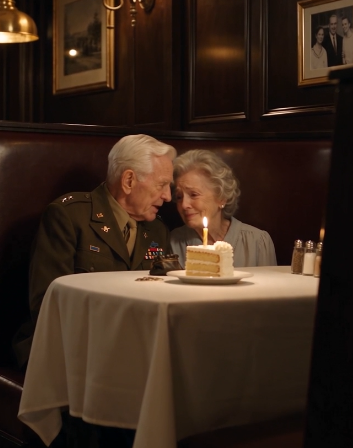
The old couple had been sitting at a corner table for twenty minutes.
They were both in their eighties. The man wore a brown suit that had been mended at the elbows. The woman wore a simple blue dress and a string of pearls that were not real. They had walked in slowly, holding onto each other, and they had asked for a table for two.
The waiter had seated them near the back, behind a pillar, where they would not be seen.
They had ordered one slice of cake. A single slice of chocolate cake, with a candle on top. It was their sixtieth wedding anniversary.
Now, they were counting coins.
—
**The Coins**
The man reached into his pocket and pulled out a handful of change. Pennies. Nickels. Dimes. Quarters. He placed them on the tablecloth one by one, counting under his breath. The woman watched him, her hands folded in her lap, her eyes soft with memory.
They had been saving for weeks. They had skipped their usual grocery shopping. They had walked instead of taking the bus. They had collected cans and bottles and returned them for the deposit. All for this one slice of cake, in this one fancy restaurant, on this one special day.
They had been married for sixty years. They had raised three children. They had buried one. They had lived through wars and recessions and illnesses and loss. They had loved each other through all of it.
They had never had much money. But they had always had each other.
The waiter approached the table. He was young—maybe twenty-five—with slicked-back hair and a sneer that he did not bother to hide. He looked at the coins on the tablecloth. He looked at the old man. He looked at the old woman.
“Coins?” he said. “This isn’t a street food stall, sir.”
The old woman’s hands trembled. “Please,” she said. “Today is our anniversary. Our sixtieth.”
The waiter picked up the plate of cake. He began to carry it away.
“I’m sorry, but we don’t accept coins. You’ll have to pay with a card or cash.”
“We don’t have a card,” the old man said. “We only have coins.”
“Then I’m afraid you’ll have to leave.”
—
**The Manager**
A man stepped forward from the back of the restaurant. He was in his fifties, with grey at his temples and a suit that fit him perfectly. He was the owner of The Ivy.
“What’s going on here?” he asked.
The waiter turned. “These people are trying to pay with coins, sir. I was just explaining that we don’t accept—”
The old man reached into his jacket pocket. He pulled out a photograph. It was black and white, faded at the edges, creased from years of being carried. He placed it on the table.
“The sign on your door,” he said. “I painted it myself.”
The manager looked at the photograph. It showed two young men standing in front of the restaurant. They were laughing, their arms around each other’s shoulders. The restaurant behind them was the same—the same awning, the same windows, the same door. But it was newer then. Brighter. Full of promise.
The sign above the door read: *The Ivy — Est. 1962.*
The manager stared at the photograph. His hands began to tremble.
“This is my grandfather,” he whispered.
The old man nodded. “And this is me. We opened this place together.”
—
**The Story**
The manager’s name was Michael. He had inherited The Ivy from his grandfather, who had passed away ten years ago. He had grown up in this restaurant. He had learned to cook in this kitchen. He had heard stories about his grandfather’s early days—about the partner who had helped him build the place, about the friend who had disappeared.
“Grandpa said you sold your share,” Michael said. “He said you took the money and left.”
The old man looked at him. His eyes were heavy with sixty years of silence.
“He erased my name from the papers while I was overseas,” he said. “I was drafted. I went to war. While I was gone, he changed the paperwork. He told everyone I had sold my share and moved away. He told everyone I had abandoned him.”
Michael’s face went pale.
“When I came back,” the old man continued, “the restaurant was his. The name was his. Everything was his. I had nothing.”
“Why didn’t you fight it?”
“I tried. But I had no money for a lawyer. I had no proof. I had nothing but a photograph and a memory. And he had everything else.”
The old woman reached over and took her husband’s hand.
“We got married that year,” she said. “We had nothing. But we had each other.”
—
**The Confession**
Michael sat down at the table. He was shaking.
“I didn’t know,” he said. “My grandfather never told me.”
“He didn’t want you to know,” the old man said. “He didn’t want anyone to know.”
“What was your name?”
“Thomas. Thomas Reed.”
Michael looked at the photograph again. The two young men. His grandfather. Thomas. Friends. Partners. Brothers.
“I owe you everything,” Michael said. “This restaurant—it was half yours. It should have been half yours.”
Thomas shook his head. “I don’t want anything. I didn’t come here for that.”
“Then why did you come?”
The old woman smiled. “We came for the cake. It’s our anniversary.”
—
**The Waiter**
The waiter had been standing by the table, listening. His face was red. His hands were clasped in front of him.
“I’m sorry,” he said. “I didn’t know.”
Thomas looked at him. “It’s okay. You’re young. You didn’t understand.”
“I should have been kinder.”
“Yes,” Thomas said. “You should have.”
The waiter picked up the plate of cake and placed it back on the table. He lit the candle. He stepped back.
“Happy anniversary,” he said.
—
**The Celebration**
Michael refused to let them pay. He brought out the finest champagne, the most expensive desserts, the best dishes the kitchen could offer. He sat with them for hours, listening to their stories, learning about the man his grandfather had betrayed.
Thomas and his wife—her name was Eleanor—told him about the early days. About the long nights they had spent painting the walls and building the tables. About the first customers who had walked through the door. About the dreams they had shared.
They told him about the war. About the letters Thomas had written that were never answered. About the years of silence.
They told him about their children. About their grandchildren. About the life they had built together, without the restaurant, without the money, without the recognition.
They had been happy. Not rich. Not famous. But happy.
—
**The Photograph**
Michael asked if he could keep the photograph. Thomas said yes.
He hung it in the entrance of the restaurant, next to a plaque that read:
*The Ivy — Founded by Thomas Reed and William Hart, 1962.*
He changed the paperwork. He added Thomas’s name to the official records. He gave him a share of the restaurant—not because Thomas asked for it, but because it was the right thing to do.
Thomas and Eleanor came back every year on their anniversary. They sat at the same corner table. They ordered the same chocolate cake. They paid with coins—not because they had to, but because it had become a tradition.
And every year, Michael was there to greet them. He called them by their names. He called them family.
—
**The Lesson**
Never judge someone by the coins in their pocket. Never assume that someone who looks poor has nothing to offer. Never let pride or prejudice keep you from seeing the truth.
Thomas and Eleanor had been married for sixty years. They had raised a family. They had survived a war. They had built a life together.
They had also been betrayed by someone they trusted. They had been erased from a story they helped write. They had been forgotten.
But they had never forgotten each other.
And in the end, that was what mattered most.