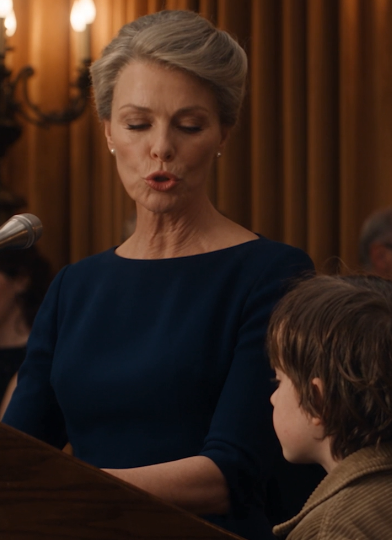

Eleanor was reaching for the microphone when a boy placed a folded drawing over her speech.
The foundation’s annual student reception was in full swing. Crystal glasses clinked. Conversations hummed. Eleanor had spent weeks preparing her remarks about the importance of arts education, about the way a single teacher could change a child’s life, about the paintings that had shaped her own childhood. She had practiced the speech in front of her bathroom mirror. She had timed it. She had worn her mother’s pearl earrings for luck.
And then a boy she had never met put a piece of paper on top of her notes.
She looked down.
A little girl stood beneath a crooked tree, her red coat the only color on the page. The tree leaned to one side, as if it had grown tired of standing straight. The girl’s arm was raised, reaching for something. A kite string was tied around her wrist.
Eleanor stopped smiling.
Her hand moved to the drawing. She touched the edge of the paper. It was soft, the kind of paper children use when they are still learning how much pressure to apply.
“Who showed you this painting?” she asked.
“Nobody. I drew it from the real one.”
She looked at the kite string tied around the little girl’s wrist. The detail was too specific. Too deliberate. The red coat. The crooked tree. The kite that was always just out of reach.
“That painting burned,” she said.
“No, ma’am.”
Her brother approached, reminding her that the guests were waiting. Grant was three years older than Eleanor, and he had spent most of his life managing the family’s affairs with a calm that sometimes felt like distance. He had been the one to handle the estate after their mother died. He had been the one to tell Eleanor about the fire. He had been the one to hold her while she cried.
Eleanor ignored him.
“Where did you see it?”
The boy pointed. His name was Milo, and he was eleven years old. His mother worked in Grant’s house, cleaning and cooking and doing all the quiet work that kept a large home running. Milo sometimes waited for her in the study after school, sketching in a notebook while she finished her rounds.
He had been sketching in the study when he saw the painting.
“In his study,” he said.
Her brother’s fingers tightened around his champagne glass.
Eleanor turned toward him.
“You told me you watched it burn.”
The words landed like stones in still water. The guests nearest to them fell silent. A woman in a blue dress turned her head. A man with a silver tie stopped mid-sentence.
For years, Eleanor had grieved something she believed was gone forever. She had mourned not just the painting but the woman who had made it. Her mother had been a painter, not a famous one, but a good one. She had painted portraits of family members, landscapes of the countryside, and one painting of Eleanor as a child, standing beneath a crooked tree, waiting for someone to rescue her kite.
It had been her mother’s last completed work.
Their mother had left it to Eleanor in her will. The painting was meant to hang in Eleanor’s home. It was meant to be passed down. It was meant to remind her that even when the kite seemed lost, someone would come.
After a fire damaged the old studio, Grant had handled the surviving artwork. He had sorted through the wreckage. He had catalogued what remained. He had told Eleanor, with tears in his eyes, that her portrait was among the losses.
She had believed him.
“I had it moved before the fire,” he admitted. “Once you thought it was gone, I didn’t correct you.”
“Why?”
“I wanted something of hers that was mine.”
“You already had things she left you.”
He looked down.
Eleanor understood then that he had wanted this particular painting because their mother had chosen someone else to receive it. He had wanted the thing that had been given to her. Not because he loved it, but because he could not bear that it was not his.
Milo’s mother worked in Grant’s house. The boy sometimes waited in the study after school, sketching while she finished. When he received an invitation to the foundation’s student reception, he brought his favorite drawing to show Eleanor. He had expected advice about the tree. The tree was always hard to draw. The branches never looked right.
Instead, the adults around him had fallen silent.
Eleanor knelt beside him. The room was still quiet, but the quiet had changed. It was no longer the quiet of a conversation interrupted. It was the quiet of something being understood.
“You haven’t done anything wrong,” she said.
Milo nodded. He was holding his pencil so tightly that his knuckles had gone white.
The painting was returned after its identity and ownership were checked against the family’s records. Eleanor did not announce that everything was forgiven. Her brother’s explanation had answered the question without repairing the trust. Some things, once broken, could be mended. Others could only be carried.
At home, she hung the portrait where afternoon light reached the red coat. It was smaller than she remembered. The colors were softer. The little girl in the painting looked impatient, as if she had been waiting for a very long time.
Beside it, in a smaller frame, she placed Milo’s drawing.
When he visited, he noticed that he had drawn the kite too large. It was almost as big as the tree. It was almost as big as the sky.
Eleanor looked at both pictures.
“I rather like yours,” she said. “You gave it more room to fly.”
Milo smiled. It was the first time she had seen him smile.
And for the first time in years, Eleanor felt the kite string loosen around her wrist.