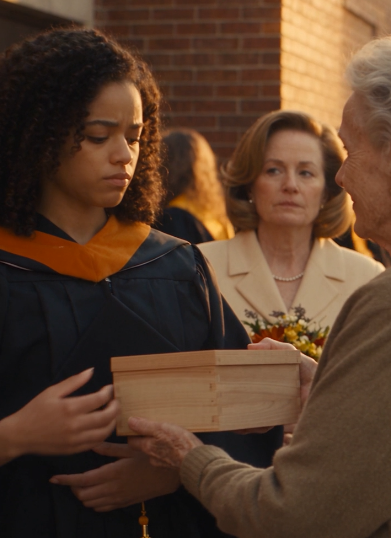

Natalie was waiting for her graduation photograph when a woman placed a wooden box in her arms.
The ceremony had just ended. The auditorium doors had swung open, releasing a flood of graduates in blue gowns and families clutching bouquets and cameras. Natalie had been standing near the edge of the crowd, adjusting her cap, when the woman appeared. She was older, perhaps in her sixties, with silver hair pulled back and a face that seemed to carry a weight Natalie could not yet name.
“I think you have the wrong person,” Natalie said.
“Your father kept these for you.”
Her smile disappeared.
“He never wrote to me.”
The woman opened the lid.
Inside were bundles of old envelopes, their edges softened by years. They were tied with string, the way people used to save things that mattered. Some of the ink had faded. Some of the corners had curled. But the handwriting on the front was unmistakable. It was her father’s. She had seen it only once, on a birthday card she had found in her mother’s drawer when she was twelve. She had memorized it without meaning to.
“He wrote every birthday,” the woman said.
Natalie lifted one. The envelope was still sealed.
“Then why didn’t I get them?”
“They came back.”
Her mother stepped forward.
“Natalie. Come away.”
But Natalie stayed where she was. The box was heavy in her arms, heavier than it should have been. It was not just the weight of paper. It was the weight of years. The weight of every birthday she had spent wondering why her father had forgotten her. The weight of every Christmas, every graduation, every milestone that had passed without a word.
“How did they all come back?” she asked.
Her mother lowered the flowers. Diane had been holding them since the ceremony ended, a bouquet of white roses and baby’s breath. Her hands were trembling.
For years, Natalie had understood her father’s absence as a choice he made again every birthday. She had built a story out of it. She had told herself that he was not the kind of man who stayed. She had told herself that she was better off without him. She had told herself that the silence was his answer.
Now she was holding something that suggested the story was far less simple.
—
Diane asked to leave the crowd. Natalie agreed, but she took the box with her.
On a quiet bench beside the auditorium, her mother admitted that she had returned the letters. The bench was old, its paint peeling. The sun was warm on Natalie’s shoulders. A few students walked past, laughing, their families trailing behind them.
“At first, I was angry,” Diane said. “Later, I didn’t know how to explain what I’d already done.”
“So you kept doing it.”
“Yes.”
Natalie looked at the woman who had brought the box. Her name was Ruth. She had not introduced herself. She had simply appeared, as if she had been waiting for the right moment.
“Is he alive?” Natalie asked.
“He is.”
The answer brought relief, then anger of a different kind.
“Why didn’t he try harder?”
Ruth did not defend him. She did not offer excuses. She did not tell Natalie that her father had been heartbroken or that he had done his best.
“You should ask him that.”
The letters were not a complete explanation of her childhood. They could not settle every argument between her parents or excuse the years her father had allowed to pass without finding another way to reach her. They could not undo the birthdays she had spent alone. They could not bring back the graduation she had just celebrated without him.
But they proved that one thing she had been told was untrue.
—
Natalie read them over several evenings.
She read them in her apartment, at her kitchen table, with a cup of tea that always went cold. Some were awkward. Some repeated themselves. One contained a drawing of a bicycle he hoped to teach her to ride. Another asked about subjects she liked at school. Another described a park he thought she would enjoy. The later letters became shorter. The handwriting grew more hurried. The last simply said that, if she ever wanted to meet, he would come.
Ruth had seen Natalie’s graduation announcement and contacted the university to ask how she could leave a message. Natalie’s father had asked her to bring the box, afraid that his own appearance would overwhelm the day.
Two weeks later, Natalie met him in a café.
It was a small place, tucked between a bookstore and a bakery. The windows were steamed from the coffee machines. The air smelled of cinnamon and roasted beans. He was already there when she arrived, sitting at a table near the back. He stood when she walked in.
She sat down before he could reach for her.
“I have questions.”
“I know.”
“Some of the answers may make me angry.”
He nodded.
“I’ll stay.”
Their first conversation lasted nearly three hours.
He told her about the letters. He told her about the phone calls that had gone unanswered. He told her about the trips he had planned and cancelled because he was afraid of making things worse. He told her about the years he had spent wondering if he had lost her for good. He did not ask for forgiveness. He did not tell her that her mother was to blame. He simply answered her questions, one by one, until the café began to empty and the light outside turned gold.
Natalie did not leave with a repaired childhood. She left with his telephone number, several difficult truths, and the choice of whether to meet again.
For the first time, that choice was hers.
She walked home slowly, the box of letters under her arm. The evening was cool, and the streets were quiet. She thought about the bicycle he had drawn, the park he had described, the birthdays he had marked with words she had never read. She thought about the years she had spent believing that she had been forgotten. She thought about the years he had spent knowing she believed it.
She did not know yet what she would do. She did not know if she would call him. She did not know if she would write back. But she knew that the story she had carried for so long was not the only story. And that, for now, was enough.