The Little Girl Brought a Ring to the Wedding and Said, “Grandma Said She Doesn’t Want to Pretend to Be Dead Anymore”110

**Title: **
The wedding reception was in full swing when the little girl walked up to the head table.
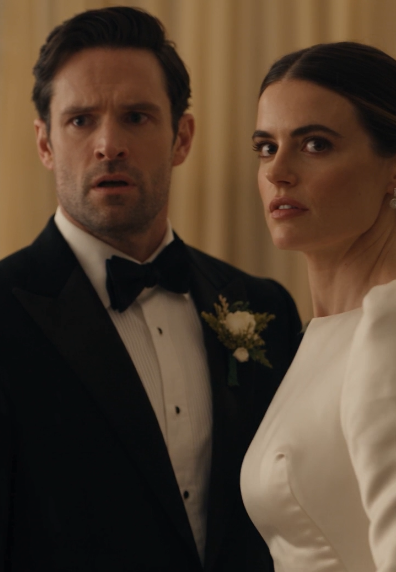
The band was playing something soft and romantic. The guests were laughing, drinking champagne, celebrating the union of Ethan and Olivia. The bride was radiant in her ivory gown. The groom was handsome in his tailored suit. It was the kind of wedding that would be photographed for magazines—elegant, expensive, flawless.
And then Lucy appeared.
She was eight years old, small for her age, with dark hair pulled back in a ribbon and eyes that were too serious for a child. She was wearing a simple blue dress that had been bought secondhand. She was carrying a small velvet box—old, worn at the corners, faded with time.
She placed it on the table in front of Ethan.
He looked at the box. He looked at the girl. He did not recognize her.
“What’s this?” he asked.
Lucy did not answer. She simply pushed the box toward him.
Ethan opened it.
Inside was a gold ring. A wedding band. Simple, unadorned, with a small dent on one side.
His hand stopped.
He recognized it. He recognized it immediately.
It was his mother’s wedding ring.
“Where did you get this?” he whispered.
Lucy looked at him with those serious eyes.
“Grandma said to give it back to you. She said she doesn’t want to pretend to be dead anymore.”
—
**The Silence**
The music stopped. The dancers froze. The guests turned to look.
Olivia stepped forward. Her smile had disappeared. Her face was pale.
“What did she say?”
Lucy did not repeat herself. She simply pointed toward the door of the reception hall.
Ethan turned.
And there, standing in the doorway, was his mother.
—
**The Woman at the Door**
Margaret was old now. Her hair was silver, her face lined, her shoulders bent. She wore a dark coat that had seen better days and carried a bag that had been mended at the handles. She did not step forward. She did not smile. She simply stood there, waiting.
Waiting for permission.
Ethan felt his heart stop.
He had not seen his mother in three years. He had not spoken to her in two. He had told everyone—his friends, his colleagues, his fiancée—that she was dead.
He had told Olivia that his mother had died when he was a child. He had told her that he had no family. He had told her that he was alone in the world.
And she had believed him.
Olivia walked toward the door. She passed Ethan without looking at him. She stopped in front of Margaret.
“You’re his mother?”
Margaret looked past her, toward her son.
“Ask him why he needed me to be dead.”
Olivia turned back to Ethan. Her eyes were filled with something he had never seen before—not anger, not sadness, but something deeper. Something colder.
“Ethan?”
He did not answer.
“Ethan, what is she talking about?”
He opened his mouth. No words came out.
—
**The Story**
Margaret had been a seamstress. She had worked from home, sewing and mending and altering clothes for neighbors and friends. When Ethan was small, she had sewn his Halloween costumes by hand. She had made his school uniforms. She had patched his jeans when he fell off his bike.
When Ethan’s father died, Margaret had taken a second job cleaning hotel rooms. She had worked double shifts, seven days a week, to keep the small apartment and put food on the table. She had never complained. She had never asked for help.
She had done it all for her children—Ethan and his younger sister, Lucy.
Ethan had been a good student. He had worked hard. He had earned a scholarship to a prestigious university. He had graduated with honors. He had landed a job at a top firm. He had climbed the ladder, year after year, until he was earning more money than his mother had ever dreamed of.
And somewhere along the way, he had become ashamed.
He was ashamed of the small apartment with the sewing machine in the corner. He was ashamed of the secondhand furniture and the faded curtains. He was ashamed of his mother’s worn hands and her plain clothes and her quiet, unassuming manner.
He started avoiding her. He started making excuses. He stopped coming home for holidays. He stopped calling.
And then he told his friends that his mother was dead.
It was easier that way. It was easier to say she had passed away than to explain why he never visited. It was easier to pretend he had no family than to admit he was embarrassed by the one he had.
He told Olivia the same lie. He told her his mother had died when he was a child. He told her he had been raised by distant relatives. He told her he was alone.
She had believed him. She had comforted him. She had held him while he pretended to grieve.
And then he had asked his mother not to come to the wedding.
He had gone to her apartment—the same small apartment where he had grown up—and he had told her that the wedding was small, that the family on Olivia’s side was not comfortable with certain things, that it would be better if she did not attend.
Margaret had looked at him for a long time.
“Is it them who aren’t comfortable?” she had asked. “Or is it you?”
He had not answered.
She had given him the ring—his father’s ring—and told him to keep it. She had said she did not need it anymore. She had said she hoped he would be happy.
And then she had closed the door.
—
**The Memorial**
Lucy, Ethan’s younger sister, had received the wedding program in the mail. She had opened it, expecting to see her brother’s name and his bride’s name and the schedule of events.
Instead, she had seen her mother’s name.
*In loving memory of Margaret Wells, mother of the groom.*
Lucy had called Ethan immediately.
“What is this?”
“What is what?”
“Mom’s name in the memorial section. You put her in the memorial section.”
“It was a mistake.”
“A mistake? You told everyone she’s dead.”
“I didn’t—”
“You told everyone she’s dead, and you invited her to the wedding anyway? What is wrong with you?”
Ethan had not answered.
Lucy had hung up.
And then she had gone to her mother’s apartment. She had found Margaret sitting at the sewing machine, working on a dress for a neighbor’s granddaughter. She had told her what she had seen. She had told her about the memorial. She had told her about the lie.
Margaret had not cried. She had not screamed. She had simply set down her needle and thread and said: “I don’t want to pretend to be dead anymore.”
—
**The Confrontation**
Olivia stood in the middle of the reception hall, surrounded by guests who had gone silent. She looked at Ethan.
“You told me she was dead.”
“I know.”
“You told me you had no family.”
“I know.”
“You let me choose flowers for her memorial. You let me write a tribute. You let me grieve for a woman who was alive the whole time.”
Ethan closed his eyes. “I was ashamed.”
“Ashamed of what?”
“Of her. Of where I came from. Of the apartment, the sewing machine, the secondhand clothes. I was afraid you would look at me differently if you knew.”
Olivia stared at him. “You were afraid I would look at you differently?”
“Yes.”
“I am looking at you differently now.”
She turned and walked toward the door. Margaret was still standing there, her hands folded in front of her.
Olivia stopped in front of her.
“I’m sorry,” she said. “I didn’t know.”
Margaret nodded. “I know.”
“I would have—if I had known—”
“You don’t have to explain. You didn’t know.”
Olivia turned back to Ethan.
“I need time,” she said. “I need to think.”
She walked out of the reception hall. Her friends followed. The guests began to leave. The band packed up their instruments.
Ethan stood alone in the middle of the empty room.
—
**The Aftermath**
The days that followed were quiet. Olivia stayed with her best friend. Ethan stayed in the apartment he had shared with her—the expensive apartment, the one with the view, the one his mother had never seen.
Lucy came to see him. She did not yell. She did not accuse. She simply sat across from him and said: “You broke her heart.”
“I know.”
“She kept that ring for thirty years. She never sold it, even when we didn’t have enough money for rent. She said it was one of the only things she had left of Dad.”
“I know.”
“She didn’t want to come to your wedding to beg for a seat at the head table. She came because she’s still alive. She wanted you to know that.”
Ethan buried his face in his hands.
“What do I do?”
“You start by telling the truth. To everyone. To Olivia. To your friends. To yourself.”
—
**The Apology**
Ethan went to his mother’s apartment. He knocked on the door. She opened it.
“Mom,” he said. “I’m sorry.”
She looked at him. She did not invite him in.
“I’m sorry for lying. I’m sorry for being ashamed. I’m sorry for everything.”
She did not answer.
“I sent messages. To everyone. I told them the truth. I told them you’re alive. I told them I lied.”
She nodded slowly.
“I hear your apology,” she said. “But I don’t know when I’ll be able to trust you again.”
He nodded. “I understand.”
Before he left, he placed the ring box on the sewing machine. The same sewing machine that had been in the corner of the apartment his whole life. The same sewing machine that had made his Halloween costumes and patched his jeans and sewn his interview shirts.
Margaret opened the box. The dent was still there—the tiny mark where his father had dropped it on the floor of the workshop decades ago.
She put the ring back in her drawer.
—
**The New Beginning**
The next weekend, Ethan called and asked if he could come for dinner. Margaret looked at her calendar and chose a day when she was free.
He arrived on time.
When a neighbor saw him at the door and asked if he was a guest of Mrs. Wells, Ethan paused.
“No,” he said. “I’m her son.”
The neighbor smiled. “She talks about you all the time.”
Ethan felt something catch in his throat.
“She does?”
“Every day. She says you’re the best thing she ever made.”
Ethan knocked on the door. Margaret opened it.
“Hi, Mom.”
“Hi, Ethan.”
She stepped aside.
He walked in.
—
**The Lesson**
Never be ashamed of where you come from. Never be ashamed of the people who sacrificed for you. Never let fear of judgment make you lie about the ones who love you most.
Ethan almost lost everything—his mother, his sister, his marriage—because he was afraid. He was afraid of being seen. He was afraid of being judged. He was afraid of being less.
But the truth was the opposite. His mother was not something to hide. She was something to honor. She had given him everything—her time, her labor, her love. And he had repaid her with shame.
He would spend the rest of his life making it right.
And that was a start.