
Ella noticed him sitting beside a small travel bag, rubbing his hands together.
The station was crowded with the usual chaos of departures and arrivals—announcements crackling over the speakers, luggage wheels rattling across the tile floor, the smell of coffee and diesel and winter air. Ella had been waiting with her grandmother near the platform entrance, watching the clock, counting the minutes until their train arrived.
Then she saw the boy.
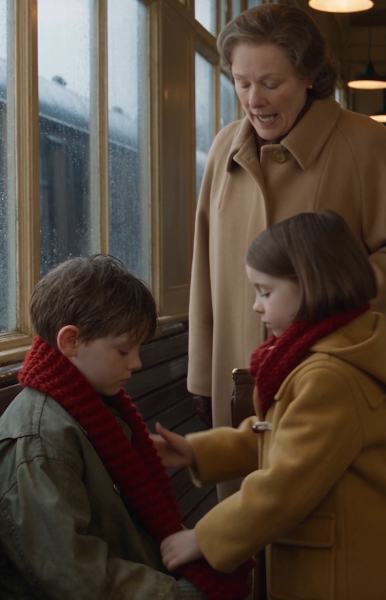
He was sitting on a bench near the ticket counter, a small travel bag at his feet. His coat was thin for the weather. His hands were red from the cold, and he kept rubbing them together, as if he could generate enough warmth to last until morning.
Without asking, Ella unwound her red scarf and wrapped it around his shoulders.
He looked up, startled. “You don’t have to—”
“It’s cold,” she said. “You need it more than I do.”
Her grandmother approached, ready to remind her about their train. Margaret was a practical woman, not unkind, but not given to sentiment. She had raised Ella since her parents died, and she had done it with a firm hand and a quiet love that did not always know how to show itself.
Then the boy lifted his hands.
Two uneven blue stars were stitched into his gray mittens.
The older woman stopped.
Margaret had seen many things in her long life. She had seen her daughter take her first steps. She had seen her husband off to war and welcomed him home. She had buried friends and family and watched the world change around her. But she had never seen stars like those. Not since Lucy.
“Who made your mittens?” she asked.
“My mum.”
“What’s her name?”
“Lucy.”
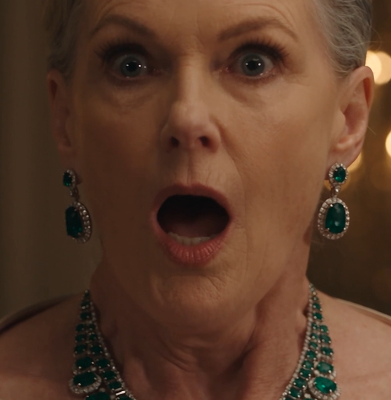
Her handbag slowly reached the floor. The leather strap slipped through her fingers, and the bag landed with a soft thud against the tile. She did not pick it up. She did not look away from the boy.
“Is she here?”
The boy glanced toward the ticket counter.
“She said you wouldn’t open the door.”
Behind them, footsteps approached.
The boy looked up.
“Mum?”
Ella’s grandmother turned—but whatever she had prepared to say seemed to disappear.
Lucy stopped several steps away.
For a moment, Margaret saw the girl who used to sit beside her sewing basket, insisting every plain mitten needed a star. Lucy had been seven years old, with pigtails and scraped knees and a determination that could wear down anyone. She had stitched stars onto everything—mittens, socks, the corners of her pillowcase. She had told Margaret that stars made ordinary things feel special.
Then Margaret saw the tired woman holding two railway tickets.
“Hello, Mum.”
Margaret stood, but Lucy did not move closer.
Sam looked between them. “You’re my grandmother?”
“Yes,” Margaret said. Her voice caught. “I am.”
Years earlier, Margaret had disapproved of the man Lucy wanted to marry. She had thought him unreliable. She had thought him careless with money. She had thought that Lucy, who had always been so bright and so stubborn, was making a mistake that would cost her everything.
Arguments about money had become arguments about judgment, then character, then whether Lucy understood anything at all. Margaret had said things she could not take back. She had told Lucy that if she married him, she would have to live with the consequences.
Their last conversation had ended with Margaret telling her not to come back asking for help.
Lucy had believed her.
Now her husband was recovering from an injury, their savings had dwindled, and she had finally traveled home to ask whether they could stay for a while. At the station, courage had failed her. She had gone to the counter to buy their return tickets.
“I didn’t know how to knock on your door,” Lucy said.
Margaret looked at the tickets.
“You shouldn’t have had to wonder whether I’d let you in.”
Lucy’s eyes filled, but her expression remained guarded. She had learned to guard herself. Margaret could see that now.
“I can’t have you speaking to Sam the way you spoke to me.”
“I understand.”
“And this doesn’t make everything all right.”
“No,” Margaret said. “It doesn’t.”
She wanted to reach for her daughter. Instead, she waited. She had learned, in the years since Lucy left, that wanting something was not the same as earning it.
Beside them, Ella adjusted the scarf around Sam’s shoulders.
“Can he keep it?”
Margaret almost smiled. “That’s yours to decide.”
Lucy looked down at the children. Ella was her brother’s daughter—a niece she had only seen in photographs. Sam was her son—a boy Margaret had never met. They were standing in a train station, surrounded by strangers, and everything that had been broken was still broken.
But they were here.
At last, Lucy stepped closer.
Margaret opened her arms slowly, giving her time to change her mind.
Lucy didn’t.
Later, when they reached the house, Margaret unlocked the front door and stepped aside.
This time, Lucy entered first.
The house was warm. The kettle was on. The sewing basket still sat in the corner, covered in dust. Margaret had not moved it since the day Lucy left. She had not been able to bring herself to put it away.
Sam pulled off his mittens and placed them on the table. The two uneven blue stars looked at Margaret like old friends.
She touched one with her finger.
“Your mum used to make stars just like these,” she said.
Sam smiled. “I know. She told me.”
Margaret looked at Lucy, who was standing in the doorway, still holding the tickets.
“You can throw those away now,” Margaret said.
Lucy looked at the tickets. Then she looked at her mother.
“I’ll keep them,” she said. “Just in case.”
Margaret nodded. She understood. Trust was not a door that opened all at once. It was a window, opened a little at a time, until the room filled with air.
For now, the window was open.
And that was enough.